

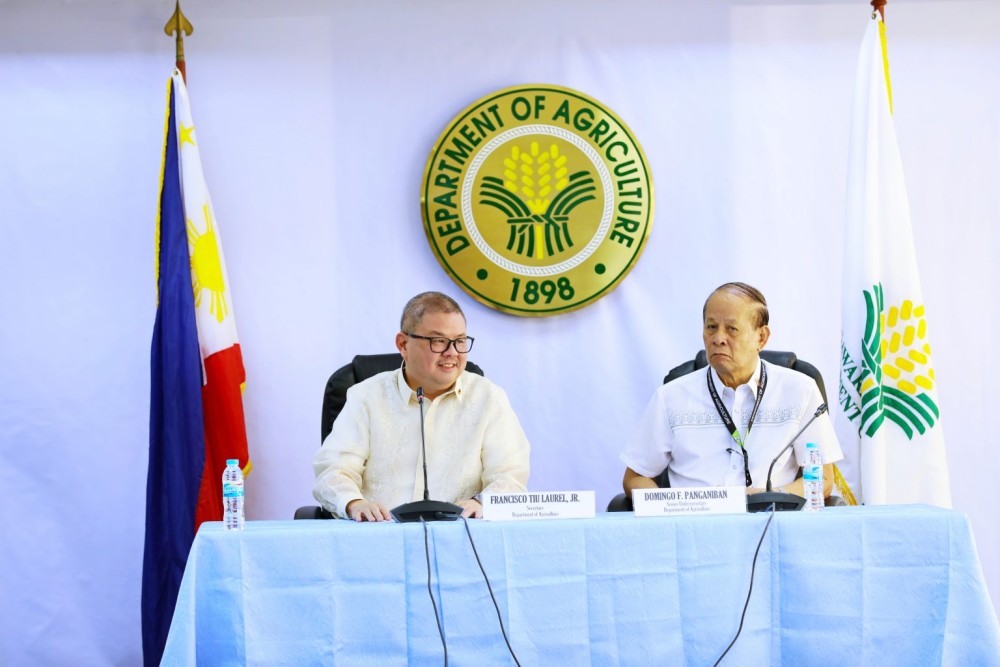
The Department of Agriculture (DA) now under the leadership of Secretary Francisco Tiu Laurel, Jr. will prioritize modernizing the country’s agri-food sector and attaining food security.
Laurel said this is based on the marching order of President Ferdinand Marcos, Jr. so the country could be food secure and less dependent on imports, and to lift millions of farmers and fisherfolk out of poverty by the time the chief executive’s term ends in 2028.
He added that modernizing agriculture can help attract more young people to the farming and fisheries industry.
“By modernizing the agriculture sector, we could make it a more profitable venture and attract a younger generation that would ensure the country’s food security in the decades to come,” Laurel said.
Government data shows that more than 10 millions farmers and fisherfolk are poor and many of them are approaching their senior years, posing a potential food crisis in the next decade.
Aside from boosting food production and modernization, the new DA chief said President Marcos told him to pay special attention to alleged price manipulation and smuggling to ensure stable supply and prices and to protect Filipino consumers.
In his first meeting with the DA family, he also sought everyone’s cooperation to achieve the goal of a stronger agriculture sector.
“I’m ready to work but I can’t do this alone. I need your full cooperation and team work for us to achieve our targets,” he said.
Programs for modernization
Right after he assumed office as Agriculture secretary in early November, Laurel led the unveiling of three pivotal projects that will help modernize the country’s farming and fishery industry: Philippine Rural Development Project (PRDP) Scale-Up; Philippine Fisheries and Coastal Resiliency (FishCoRe) Project, and Mindanao Inclusive Agricultural Development Project (MIADP).
Laurel underscored the significance of the three projects, noting that these are in line with President Marcos’ thrust to strengthen the capabilities of farmers and fisherfolks also through climate-resilient policies and innovations.
The PRDP Scale-up is designed to address the gaps in the commodity value chain by improving the efficiency of the food supply chain toward greater connectivity, mobility, accessibility, availability and affordability of food in the market. It covers all 16 regions composed of 82 provinces and will be implemented for six years until 2029.
MIADP, meanwhile, aims to increase the income of Indigenous Cultural Communities/Indigenous Peoples (ICC/IPs) farmers and fisherfolk. The MIADP has a P6.625-billion budget, of which P5.3 billion will be funded under a WB loan, P863 million as counterpart of the government, and P461 million as equity from the participating local government unit.
The FishCoRe Project, on the other hand, seeks to improve the management of fishery resources and enhance value of fisheries production in Fisheries Management Areas (FMA) 6 and 9 covering 11 regions and 24 provinces.
It has three components namely: Fisheries and Coastal Resilient Resource Planning and Management (FishCRRM); Modern and Resilient Livelihood Investments (MARLIN); and Support to Project Implementation and Management (SuPriM).
Dr. Ndiamé Diop, World Bank country director for Brunei, Malaysia, the Philippines and Thailand, emphasized the importance of the three projects in building greater resilience into agriculture.
“We are committed as a world bank, to supporting the Department of Agriculture in implementing all these projects and we look forward to closely working with all the stakeholders and the new leadership to get these projects implemented,” he said.
