

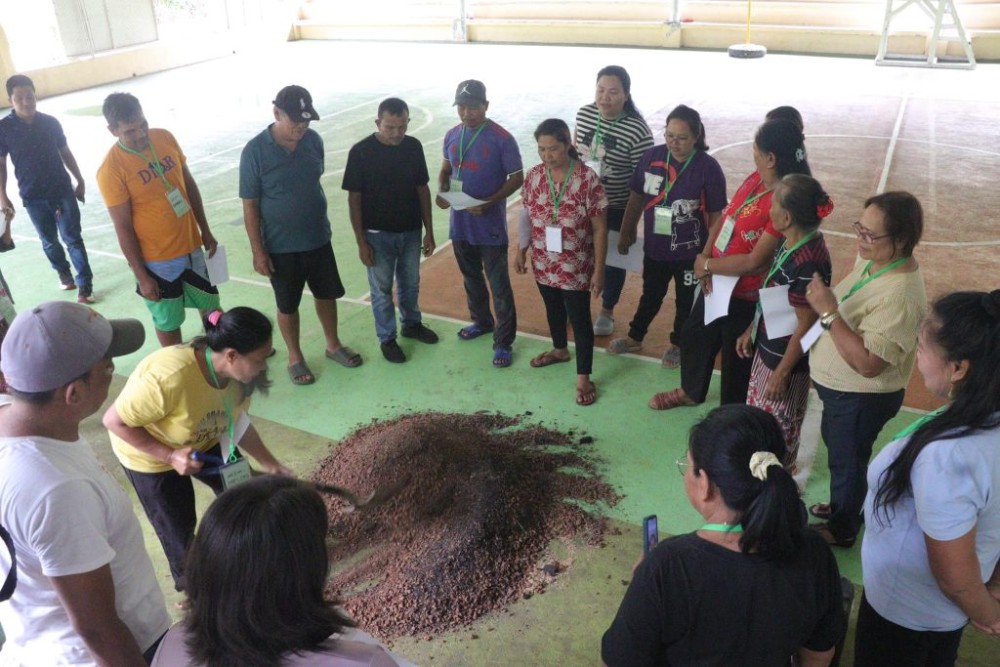
CAMIGUIN — The provincial government of Camiguin is promoting organic farming through grassroots programs to reduce dependence on chemical fertilizers and pesticides.
Aligned with the province’s Organic Agriculture Ordinance, the initiative focuses on restoring soil quality and minimizing health risks linked to inorganic inputs.
“Hopefully, we will return to our natural ways. We can restore the richness of our soil so it’s no longer hard, and we won’t need to use synthetic fertilizers. We need to teach them [farmers]. Transitioning from inorganic to organic isn’t something that happens with just a snap of a finger. It’s really a process—that’s why we are working hard to push for it,” said Louis Bollozos, chairperson of the Sangguniang Panlalawigan’s Committee on Agriculture.
To support the transition, the province created the Agricultural and Biosystems Engineering (ABE) Division under the Provincial Agriculture Department. The division is authorized to hire engineers to assist with irrigation, post-harvest systems, and related infrastructure.
Provincial Agriculturist Aida Chan said support programs remain in place, including the Plant Now, Pay Later (PNPL) scheme. With a 2.5 percent annual interest rate, PNPL offers capital assistance to farmers, fisherfolk, processors, and sari-sari store owners, payable within a year.
The Provincial Plant Nursery also supplies planting materials, including fruit trees like lanzones and other high-value crops, to residents and tourists.
Other efforts include localized information materials, school gardening (Gulayan sa Paaralan), and freshwater habitat production.
Moreover, the Kadiwa sa Kapitolyo Market provides a venue for farmers to sell produce directly to buyers. In the first quarter, organic product sales exceeded P700,000.
“We can see through Kadiwa that we have plenty of produce, thanks to the vegetable seeds we provided to our farmers,” said Chan.
With only 15 certified organic farmers in the province, Chan urged others to begin with small-scale efforts. “Let’s start small. Let’s begin in our backyards, outside our homes. Let your soil be analyzed by the Regional Soil Laboratory.”
She added that the local government plans to expand these efforts to build a more sustainable agricultural system in the province.
PIA PHOTO
