

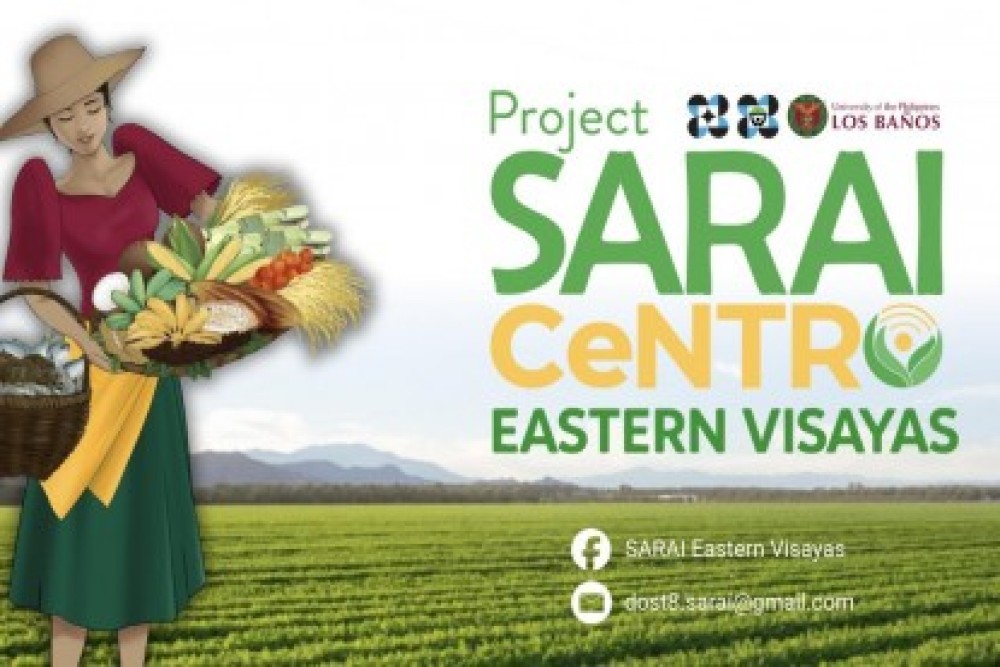
PALO, Leyte – The Department of Science and Technology (DOST) is set to open a regional hub for Project Smarter Approaches to Reinvigorate Agriculture as an Industry (SARAI) in Eastern Visayas, aiming to level up farm productivity and strengthen food security using smart, climate-ready solutions.
The DOST regional office in Palo will host the hub, which will focus on rolling out localized, data-driven tools to help farmers better cope with climate challenges, DOST Regional Director John Glenn Ocaña said in an interview on Monday.
Science and Technology Secretary Renato Solidum is scheduled to lead the hub’s opening on Jan. 22, 2026, alongside other officials from the agency’s central office.
“The regional hub is where all SARAI actions will be anchored. Agricultural data from LGUs will be consolidated and processed here to support smarter, faster decision-making,” Ocaña told the Philippine News Agency.
The hub will generate timely data and advisories for farmers, including location-specific crop recommendations, weather forecasts, and pest or disease alerts. It will also train farmers, local government units, and other stakeholders to use smart agriculture tools, such as drones for data gathering and analysis.
A key role of the facility is to localize national SARAI technologies, including SPIDTECH (Smarter Pest Identification Technology), WAISS (Water Balance-Assisted Irrigation Scheduling System), and AWS (Automatic Weather System).
SPIDTECH serves as a digital library for insect pests and plant diseases, offering detailed information on symptoms, life cycles, management practices, and other critical data.
WAISS helps farmers manage water more efficiently by alerting them when soil moisture is nearing critical levels. It provides guidance on when to start irrigating, how long irrigation should last, when to stop, and when to resume.
AWS, meanwhile, delivers real-time weather monitoring and uses site-specific historical data to support crop modeling and forecasting.
Project SARAI is an action-research program funded by the DOST–Philippine Council for Agriculture, Aquatic and Natural Resources Research and Development. It aims to reduce climate-related risks by giving farmers and other agriculture stakeholders access to site-specific, science-based crop advisories.
Priority crops under the program include rice, corn, banana, coconut, coffee, cacao, sugarcane, soybean, and tomato.
PALO, Leyte – The Department of Science and Technology (DOST) is set to open a regional hub for Project Smarter Approaches to Reinvigorate Agriculture as an Industry (SARAI) in Eastern Visayas, aiming to level up farm productivity and strengthen food security using smart, climate-ready solutions.
The DOST regional office in Palo will host the hub, which will focus on rolling out localized, data-driven tools to help farmers better cope with climate challenges, DOST Regional Director John Glenn Ocaña said in an interview on Monday.
Science and Technology Secretary Renato Solidum is scheduled to lead the hub’s opening on Jan. 22, 2026, alongside other officials from the agency’s central office.
“The regional hub is where all SARAI actions will be anchored. Agricultural data from LGUs will be consolidated and processed here to support smarter, faster decision-making,” Ocaña told the Philippine News Agency.
The hub will generate timely data and advisories for farmers, including location-specific crop recommendations, weather forecasts, and pest or disease alerts. It will also train farmers, local government units, and other stakeholders to use smart agriculture tools, such as drones for data gathering and analysis.
A key role of the facility is to localize national SARAI technologies, including SPIDTECH (Smarter Pest Identification Technology), WAISS (Water Balance-Assisted Irrigation Scheduling System), and AWS (Automatic Weather System).
SPIDTECH serves as a digital library for insect pests and plant diseases, offering detailed information on symptoms, life cycles, management practices, and other critical data.
WAISS helps farmers manage water more efficiently by alerting them when soil moisture is nearing critical levels. It provides guidance on when to start irrigating, how long irrigation should last, when to stop, and when to resume.
AWS, meanwhile, delivers real-time weather monitoring and uses site-specific historical data to support crop modeling and forecasting.
Project SARAI is an action-research program funded by the DOST–Philippine Council for Agriculture, Aquatic and Natural Resources Research and Development. It aims to reduce climate-related risks by giving farmers and other agriculture stakeholders access to site-specific, science-based crop advisories.
Priority crops under the program include rice, corn, banana, coconut, coffee, cacao, sugarcane, soybean, and tomato.
